
Can you permanently damage your metabolism by not eating enough?
If you’re an active midlife woman like me—running, hiking, cycling, and just trying to stay strong—I’d bet good money you’ve bought into the exact same lie I did for years…and yes even as a nutrition professional.
The narrative is everywhere, from PT’s to random ‘influencers’ if your body composition isn't changing, or if that scale keeps creeping up, you just need more discipline. You need to eat a little less, move a little more, and push harder (and OK in some cases this could be true). So, I turned to rigid, ultra-low-calorie protocols like Metabolic Balance. I strictly weighed my food, cut out whole food groups, and kept logging hard endurance sessions on absolute empty.
And look, I am not saying those sorts of strategies cannot work for a small amount of time, they can and it DID help me shift my weight in a meaningful way but it was the long term cost to my metabolism, especially as a strong woman, where this was the wrong way forward.
After some years sticking to Metabolic Balance strictly, my energy started to tank, my recovery hit a wall, and then my weight completely stalled. But here was the scariest part: when I tried to eat normal, nourishing portions again, I put on weight almost immediately—even while putting in hours of exercise every single week. Then perimenopause kicked in on top of that, and it felt like my metabolic engine had completely blown up.
So, can you actually damage your metabolism by not eating enough?
The short answer is no, you haven't broken it permanently, but you can suppress it drastically. What you're experiencing when this occurs, is a brutal, natural survival mechanism called adaptive thermogenesis, compounded by midlife endocrine shifts.
Here’s what is happening in your body, why fixing it requires some short-term nerve, like a whole lot of nerve (and yes, some temporary weight gain), and how tracking Energy Availability (EA)—the core foundation behind Sérénité Active—can help you rebuild your baseline engine for good and get back to living your life feeling good in your skin.
The Trap of Chronic Restriction - Adaptive Thermogenesis & The Famine Response
When you chronically slash your calories while keeping your workout load high, your brain doesn't look in the mirror and think, "Great job working on that weight loss goal!"
It thinks you're surviving a severe famine.
To keep you alive, your body kicks off adaptive thermogenesis (metabolic adaptation). It systematically dials down your Resting Energy Expenditure (REE)—meaning your baseline daily metabolic burn drops far lower than it normally would for a woman of your size and muscle mass (if you are a larger built woman) but this works the same with all women. (Trexler et al., 2014; Martins et al., 2020).
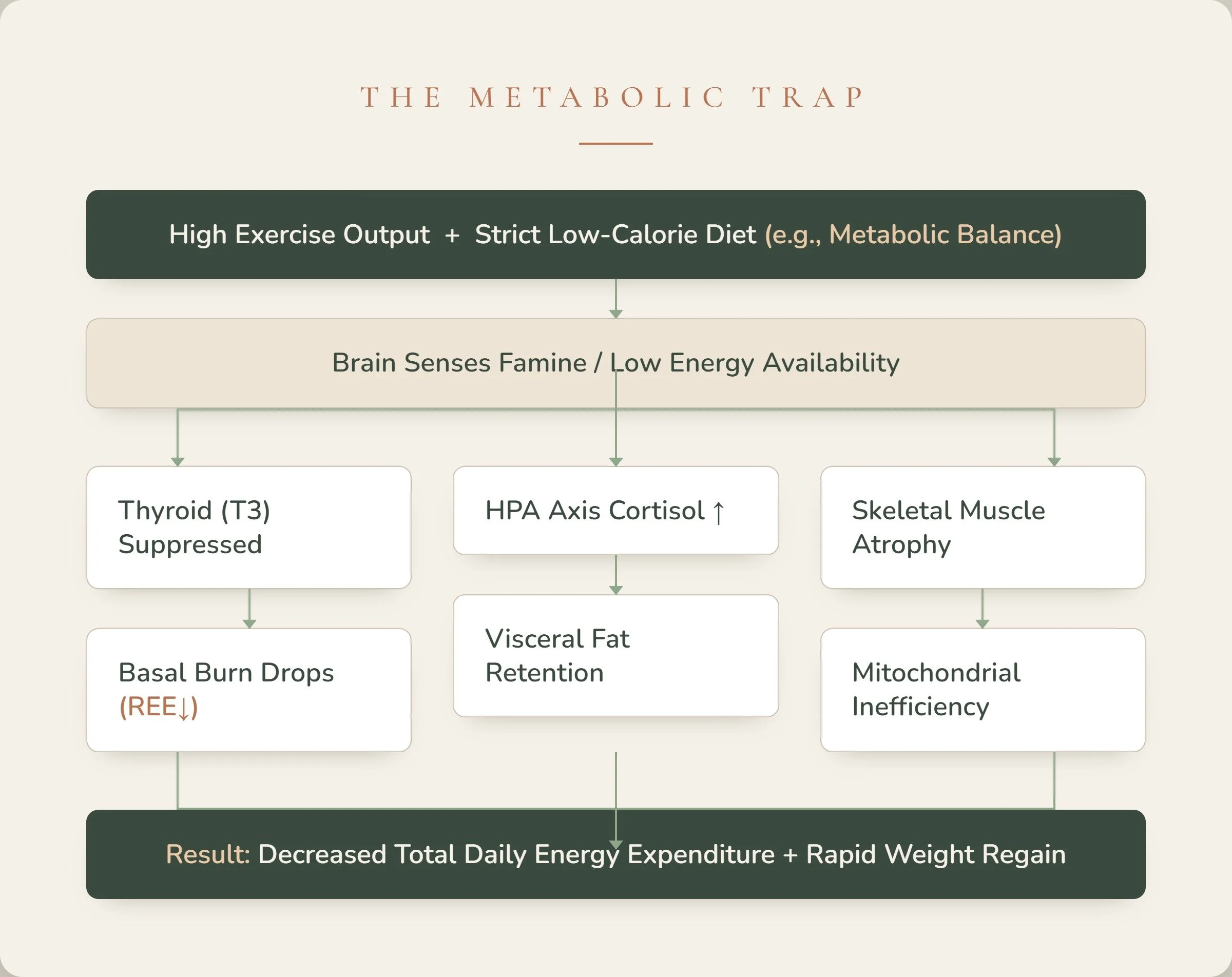
When you exist in a severe chronic deficit, your body adapts to protect you:
Thyroid Down-Regulation: Your body stops converting thyroxine (T4) into active triiodothyronine (T3) at normal rates (Holtzman et al., 2024). Active T3 sets your metabolic idle speed. When it drops, your baseline engine slows right down.
Cortisol & Stress Response: Long-term deficits act as a continuous biological alarm, spiking chronic cortisol (Nattiv et al., 2021). That constant stress signal triggers stubborn central fat retention and leaves you chronically inflamed. This was one of the key issues I had when I was training for my triathlon.
Muscle Loss: When fuel is scarce, your body burns through lean muscle tissue for emergency energy, shrinking the very tissue that drives your daily energy burn, but in my case, I actually built muscle despite all I was asking of my body, this if of course rare and probably due to the testosterone I was supplementing with that saved my muscle!
Your Total Daily Energy Expenditure shrinks to fit your restricted intake. So when you inevitably try to eat like a normal human again, your dialed-down metabolism can't process it, and your food gets stored almost instantly.
The Perimenopause Multiplier
If adaptive thermogenesis sets the metabolic trap, perimenopause springs it shut. As if we needed anymore good news right?
During midlife, erratic spikes and eventual drops in 17-beta-estradiol completely rewrite how your body handles fuel, stress, and recovery (Greendale et al., 2019; Holtzman et al., 2024).
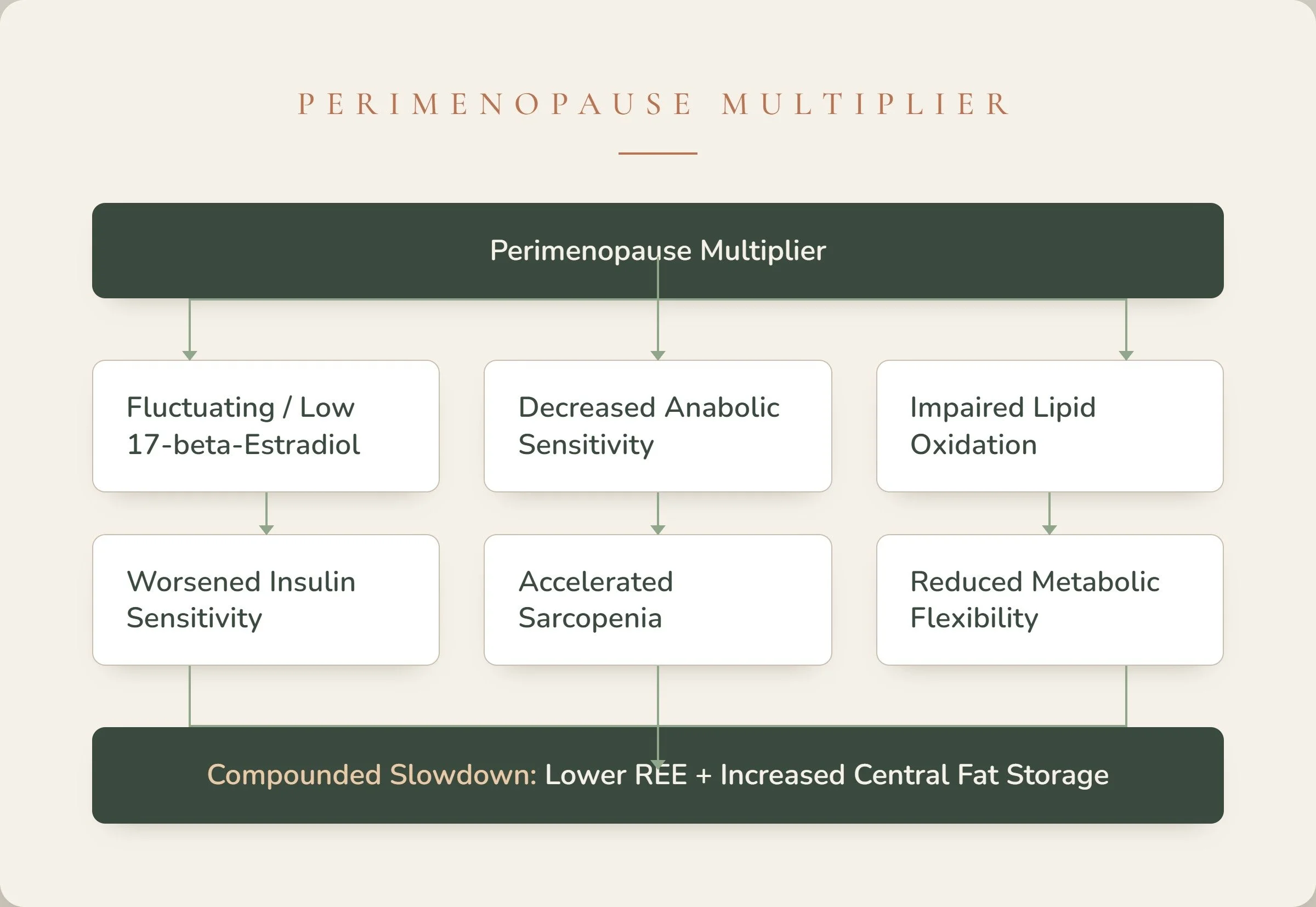
Worsened Insulin Sensitivity: Estrogen helps your body use carbohydrates efficiently. As 17-beta-estradiol fluctuates, your cells become less sensitive to insulin, making it harder to push fuel into muscle stores and easier to store as visceral fat.
Accelerated Sarcopenia: Estrogen plays a vital role in muscle maintenance and repair. As it declines, active women experience accelerated muscle loss unless they intentionally counteract it with heavy lifting and high protein intake (Buckinx & Aubertin-Leheudre, 2022). Heavy lifting of course is going to be nuanced for each women individually.
Impaired Fat Burning: Low estrogen reduces your metabolic flexibility—your body’s ability to seamlessly switch between burning carbs and fat during exercise and rest. And my gosh did mine feel beyond broken.
Low Energy Availability (LEA) & REDs in Active Females
In sports science, the condition caused by chronic under-fueling is called Low Energy Availability (LEA), which forms the core of Relative Energy Deficiency in Sport (REDs) (Mountjoy et al., 2023). You may be familiar with these terms from hearing Dr S Sims speak - she is a smart woman and correct. I am a huge fan of most of what she advocated for.
Energy Availability (EA) measures how much energy your body has left over for basic survival functions after accounting for your workouts:
EA = (Energy Intake in kcal - Exercise Energy Expenditure in kcal) / Fat-Free Mass in kg
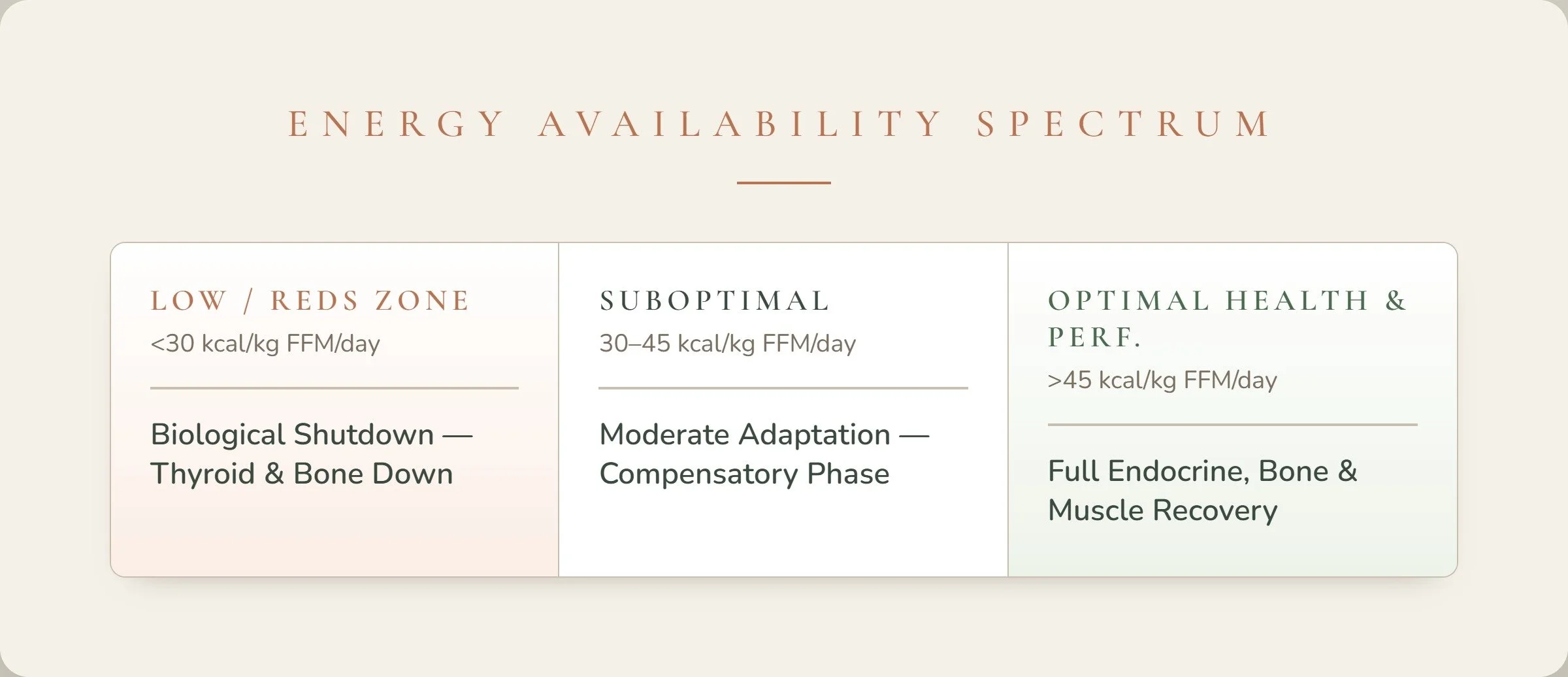
If you burn 500 kcal on a run and only eat 1,400 kcal all day, you are leaving your body with barely anything to power your heart, brain, immune system, and hormonal repair. When EA drops below 30 kcal/kg FFM/day, your body starts turning off key biological systems:
Hormonal Shutdown: Reproductive hormones plummet, leading to disrupted cycle phases or missed periods.
Bone Loss: Bone formation markers drop while breakdown markers rise, significantly increasing stress fracture risks.
Metabolic Exhaustion: Chronic fatigue, brain fog, and poor muscle recovery become your everyday norm.
You can imagine what this starts do long term and this is where the wheels started to fall off for me.
Rebuilding My Engine -The Hard Truth About Reverse Dieting & Weight Gain
I want to be completely honest with you about what fixing this truly looks like, because almost nobody in the diet industry talks about the middle part. It is brutal, psychologically.
When I finally decided to stop starving my active lifestyle and reverse diet my way out of this hole, I put on weight.
And mentally, that was really hard to accept and I mean REALLY hard and I wanted to give up. But physiologically? It was completely normal and necessary even if it meant feeling puffy in my clothes and losing that feeling of ‘leanness’.
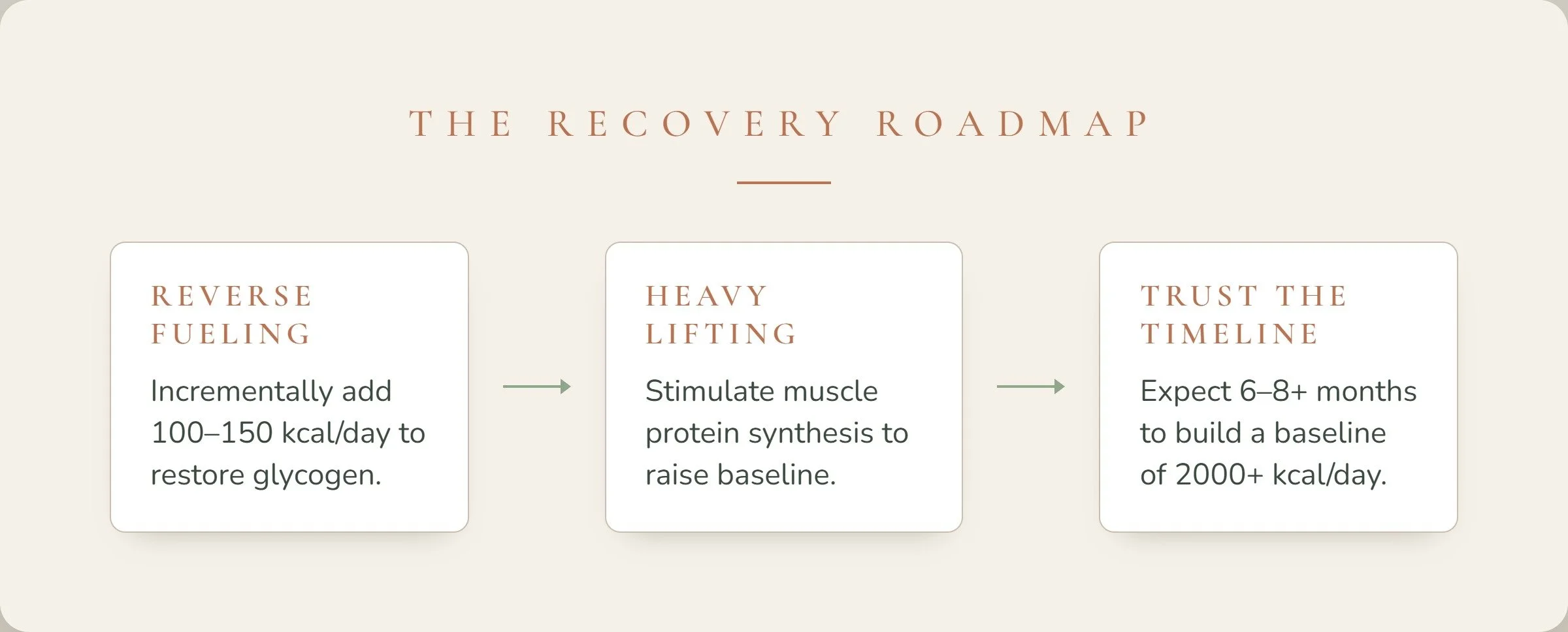
When you’ve spent months or years in chronic restriction while training hard, your muscles become radically depleted of glycogen (the stored form of carbohydrates). For every single gram of glycogen your body restores as you start eating adequate food, it also stores about 3 to 4 grams of water. That initial scale increase isn't "sudden fat"—it’s your starved, dehydrated muscle tissue finally soaking up water and fuel like a dry sponge. And boy mine did an amazing job of it LOL.
Beyond glycogen replenishment, an adapted body needs time to realize the famine is over. You cannot expect a metabolism that has been suppressed for years to adjust overnight.
For me, it took eight full months of changing things up, lifting heavy, trusting the reverse fueling process, and balancing my Hormone Replacement Therapy (HRT) for my body to finally feel safe again. Today, my body is thriving on a baseline of 2,200 calories a day, and then I fuel on top of that for whatever running, hiking, or cycling I do that day. Even that amount is a work in progress as I move around a lot and technically I should be eating more but I have had to slowly triage my intake as my stomach was not used to eating so much and initially it led to SIBO which took a whole lot of time to settle. Trying to run and cycle feeling like a bloated toad is not fun.
Getting your body back to a state of safety takes time, more time than I was comfortable with, but living in chronic metabolic suppression is a far worse place to stay.
Why Sérénité Active is Built Differently
So with that in mind, it is the reason I built an app and rolled 7 years of clinical research, coaching and personal experience into one place.
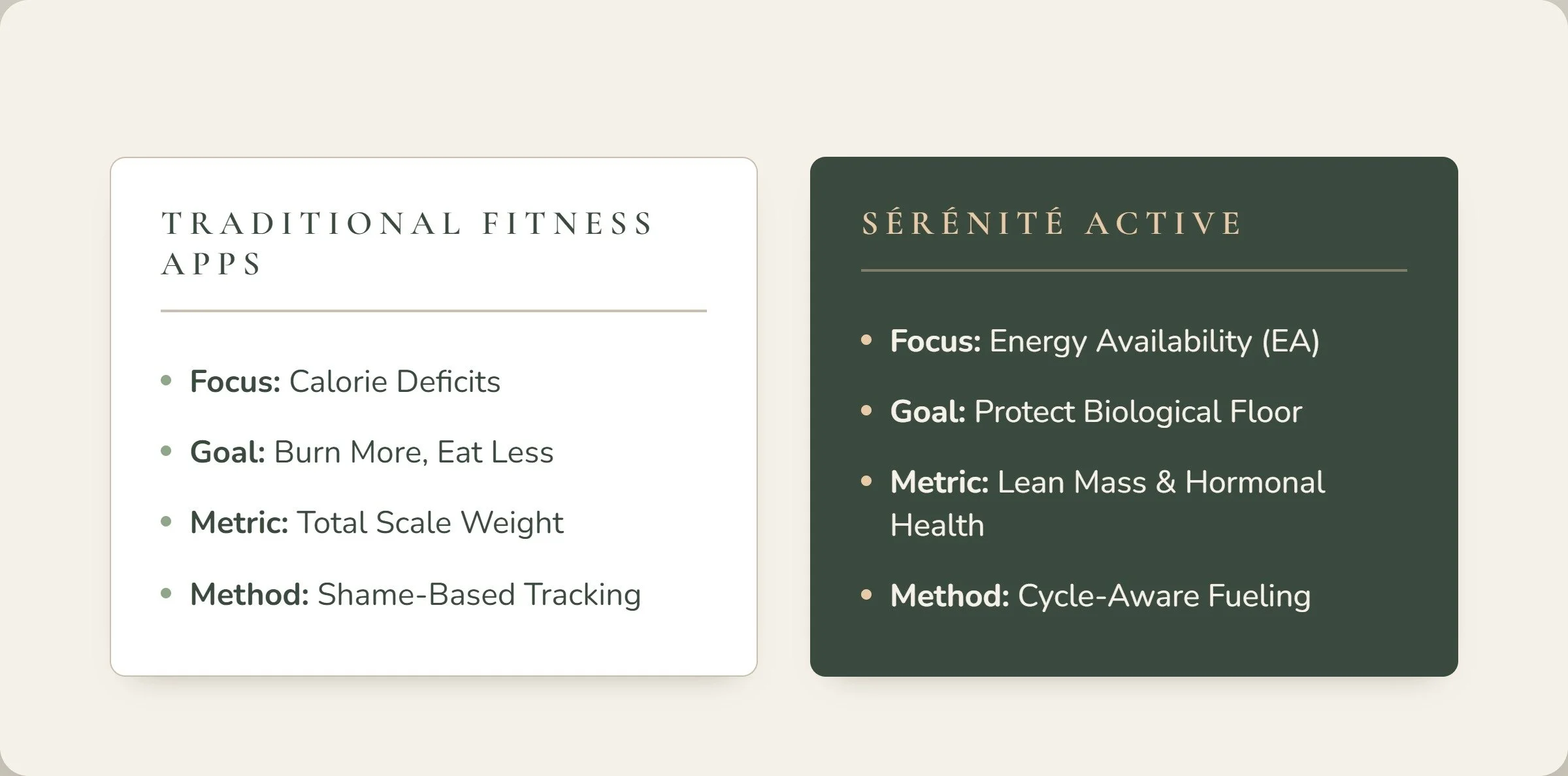
Traditional weight-loss apps are designed around a broken rule: Always stay in a calorie deficit. They color-code your food red, penalize you for fueling your body, and treat exercise like a punishment to earn calories back. They are also built on ridged male algorithms. For an active midlife woman dealing with perimenopause, that model is a direct path to metabolic burnout. I built Sérénité Active to be a sanctuary from restrictive diet culture.
Instead of tracking deficits, Sérénité Active calculates your Energy Availability (EA), helping you preserve your biological floor (>30–45 kcal/kg FFM/day) on active days. It factors in perimenopausal hormonal shifts, showing you exactly when to fuel up so you can train hard, recover fully, and protect your long-term metabolic vitality. And a ton more features. It is a very special app and it truly teaches you to nourish your changing body while continuing to live the active life you love.
You didn't break your metabolism forever, but it is time to stop shrinking it.
To learn more about my app click here
References
Buckinx, F. and Aubertin-Leheudre, M. (2022) 'Sarcopenia in Menopause: Pathophysiology and Prevention Strategies', Maturitas, 160, pp. 12–19.
Greendale, G.A., Sternfeld, B., Huang, M., Han, W., Karvonen-Gutierrez, C., Ruppert, K., Cauley, J.A., Finkelstein, J.S., Jiang, S.F. and Karlamangla, A.S. (2019) 'Changes in body composition and weight during the menopausal transition: the Study of Women's Health Across the Nation (SWAN)', JCI Insight, 4(5), e124865.
Holtzman, B., Ackerman, K.E. and Elliott-Sale, K.J. (2024) 'Endocrine Adaptations to Low Energy Availability in Active Women Across the Lifespan', Sports Medicine, 54(2), pp. 245–259.
Martins, C., Roekennes, A., Salamati, B., Gower, B.A. and Hunter, G.R. (2020) 'Metabolic adaptation after weight loss: a review of its physiological mechanisms and clinical implications', Obesity Reviews, 21(9), e13054.
Mountjoy, M., Ackerman, K.E., Bailey, D.M., Burke, L.M., Constantini, N., Hackney, A.C., Heikura, I.A., Melin, A.K., Pensgaard, A.M., Stellingwerff, T. and Sundgot-Borgen, J.K. (2023) '2023 International Olympic Committee (IOC) consensus statement on Relative Energy Deficiency in Sport (REDs)', British Journal of Sports Medicine, 57(17), pp. 1073–1097.
Nattiv, A., De Souza, M.J., Koltun, K.J., Misra, M., Kussman, A., Williams, N.I., Kraemer, R.R. and Barrack, M.T. (2021) 'The Female and Male Athlete Triad Coalition Consensus Statement on Treatment and Return to Play', Current Sports Medicine Reports, 20(9), pp. 520–533.
Trexler, E.T., Smith-Ryan, A.E. and Norton, L.E. (2014) 'Metabolic adaptation to weight loss: implications for the athlete', Journal of the International Society of Sports Nutrition, 11(1), p. 7.
About the Author: Combining professional expertise with personal insight, I am a nutritional scientist dedicated to changing the conversation around women's hormonal health. Having navigated the hidden complexities of HRT over-treatment myself, I bridge the gap between clinical research and real-world experience to ensure women have the tools they need to advocate for their health. If you're a woman in perimenopause struggling with metabolic health despite doing "all the right things," the missing piece might be understanding your unique internal landscape.
