
Fueling Endurance Through Perimenopause With a Trauma History
There is a woman the research has not met yet.
She is somewhere between 41 and 55 maybe a little younger. Her cycle has become unreliable in a way that is nothing to do with her training. She does long events, a half, a marathon, an ultra, a multi-day hike, an ocean swim and during the week she trains when she has time around her work and life schedule, but on a Saturday she is out for two or three hours in one block. She is not elite. She is not doing fifteen hours a week. But her body cannot tell the difference, because two hours of continuous aerobic work makes the same metabolic demands whoever you are.
And she is carrying something else, a history of complex emotional trauma, or attachment wounds, or a childhood that taught her that needs were negotiable and that she has to earn love or approval.
I have spent a long time reading the literature that is supposed to serve her. I am a nutritional scientist. I also, broadly, am her. What I would like to achieve in this blog is really an overview of what we know currently, where the gaps are and how we can work with what we have until we have more research to go on.
Three bodies of research that don’t “know” each other
There is good work on perimenopause. There is good work on endurance fueling and under-fueling. There is good and growing work on trauma and reproductive ageing. What there is not, as far as I can find, is a single study, intervention, or even qualitative exploration that holds all three at once. I was surprised by this but also saw it as an opportunity to serve this exact group of women.
What we know about fueling in perimenopause is less than you would hope
The International Society of Sports Nutrition’s position stand on the female athlete is the most authoritative document we have, and it is candid about its own limits: “a widespread lack of studies in females assessing nutritional strategies for performance, body composition manipulation, and supplementation exists across the literature” (Sims et al., 2023). Its practical advice for peri- and postmenopausal athletes is essentially to self-experiment: track hormonal status “against training and recovery metrics to determine the individual’s unique patterns.” Not entirely helpful for the women in the gap.
It does however make real recommendations, and they are worth knowing. Daily protein for peri- and postmenopausal athletes in the mid-to-upper range of sports nutrition guidelines, the paper gives 1.8–2.0 g/kg/day specifically for perimenopause, “due to the decline of estradiol and the ensuing insulin and anabolic resistance coupled with the demands of physical activity” — distributed every three to four hours, with a bolus, or (a rounded mass of chewed food) of protein containing roughly 6–10 g of essential amino acids as close to the end of exercise as possible to overcome anabolic resistance. After prolonged exercise, at least 1.2 g/kg of carbohydrate promptly, with particular attention to timing because of rising insulin resistance, taking advantage of the non-insulin-dependent first phase of glycogen synthesis that lasts only 30–40 minutes (Sims et al., 2023).
Notice what that guidance is built on. The best protein-requirement estimates for endurance work — 1.28 to 1.63 g/kg/day — come from a review explicitly titled for pre-menopausal athletes (Mercer et al.,2020). The perimenopausal numbers are inference from mechanism, not measurement. A 2025 study of Canadian middle-aged endurance athletes had five premenopausal, two perimenopausal and nine postmenopausal women, and had to pool them, stating that the female sample “was too small to evaluate differences in nutrient intake by menopause status, a research area of great importance for future research” (Ghomeshi et al., 2025). SO the jury is largely not out just yet but hey, we have something..
Meanwhile the symptom picture is vivid and mostly ignored. In 187 female endurance athletes, perimenopausal women reported the most severe symptoms — more severe than either pre- or postmenopausal women. Sleep problems affected 88% and physical and mental exhaustion 83%, and of those affected, 92% and 87% respectively said it damaged their training (Hamilton, Yarish and Heron, 2025). These numbers capture the surface. In practice the under-recovered perimenopausal endurance athlete often describes a more specific pattern: residual heaviness that outlasts normal delayed-onset soreness, appetite that stays muted for 24–48 hours after a long effort, a gut that feels unsettled longer than expected, and a general sense that the same session now costs more. When a trauma history is also present, the signals themselves can be harder to read. In 868 female masters weightlifters, more training hours were associated with worse menopausal symptoms while better performance was associated with fewer — a loop the authors describe as “simultaneous feedback” and which nobody has yet untangled (Huebner and Ma, 2023)
Under-fueling was measured in the wrong women
Relative Energy Deficiency in Sport is where fueling failures get named, and the data on women in endurance sport are sobering. Among 1,445 female trail and ultra-runners, 49.7% were at risk of low energy availability and 48% at risk of disordered eating, against 22.3% and 27% of the men in the same study (Henninger et al., 2024). Among 524 UK female endurance runners, 47.3% were at risk of low energy availability, 40% of disordered eating and 9.4% screened positive for an eating disorder (Dervish, Wilson and Curtis, 2023). Roughly one in two.
Here is the part that matters for our woman. The threshold most of this rests on — 30 kcal/kg fat-free mass per day — traces to controlled laboratory work in which four to five days below that level reduced luteinising hormone pulse frequency in sedentary, regularly menstruating women (Loucks and Thuma, 2003). A critical review of the evidence since concludes that menstrual disturbances occur both above and below it, so the figure “is not a cut-off below which menstrual disturbances occur, but represents an increased risk of experiencing menstrual disturbances” (Salamunes, Williams and De Souza, 2024). Sedentary young women, two decades ago, with menstrual disruption as the defining outcome — and in perimenopause that outcome has already been triggered by hormones. The screening tools inherit the same problem: LEAF-Q validity is contested, current Triad criteria “may not identify all women at risk,” and practitioners are now advised to pair LEAF-Q with a short eating-disorder measure precisely because compulsive exercise is not otherwise captured (Ghazzawi et al., 2026)
So, the flagship indicator of adequate fueling in women is menstrual function, assessed with instruments validated in young menstruating athletes, applied to a woman whose cycle is already disordered for entirely hormonal reasons. In perimenopause, the canary in the coal mine has already flown. The 2023 IOC REDs consensus acknowledges more broadly that cut-offs “require further scientific validation” and that “there are few prospective or cohort studies” tracking athletes longitudinally (Mountjoy et al., 2023).
Trauma and reproductive ageing, the newest, sharpest signal
This is the literature I least expected to find, and it changes the shape of the question in many ways. In a sample of over 6,000 trauma-exposed women, perimenopausal women showed significantly worse total PTSD symptoms, worse hyperarousal, and worse depressive symptoms than both premenopausal and postmenopausal women, after adjusting for lifetime trauma exposure and childhood abuse (Michopoulos et al., 2023). A 2024 systematic review of 21 studies concluded that the peri- and postmenopausal periods “appear to be particularly vulnerable phases for individuals with trauma exposure,” while noting that only four of those studies used proper STRAW+10 staging and that mechanistic insights that may explain this interaction are currently neglected (okay then?) the neuroendocrine effects of menopause on trauma-exposed brains remain unknown (Arnold et al., 2024). A scoping review of 39 studies found histories of abuse associated with more severe vasomotor, psychological and genitourinary symptoms, and menopause arriving around 20 months earlier (Mann, Hinsliff-Smith and Olewe-Richards, 2025). Grim yes and I wish we didn’t need to have this research but at least we can identify and try to fill the gaps in current knowledge and be honest about what we do and do not know.
None of these studies measured training load. None measured dietary intake.
The assumption I see AS this woman in the gap
Here is where my professional reading and my own experience meet..
Almost all midlife women’s nutrition advice including the good, evidence-based kind — assumes a woman who can feel her hunger, trust her fatigue, and tolerate rest. “Fuel by feel.” “Listen to your body.” “Eat when you’re hungry.”
Trauma and chronic stress complicates every one of those instructions.
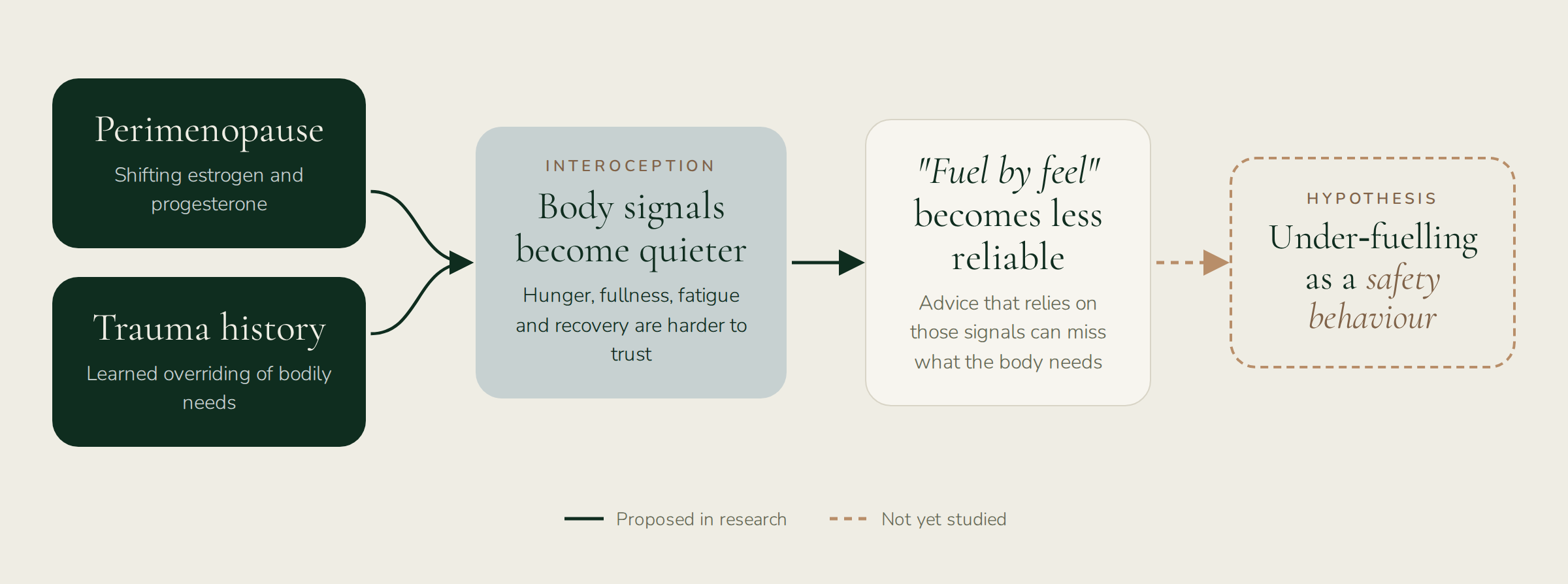
Interoception is the body’s internal sensing system (or the 8th sense) the capacity to notice and interpret signals such as hunger, fullness, fatigue, heart rate, gut state, temperature, and recovery status. When it is working well, these signals are relatively clear and usable. When it is disrupted, they become quieter, delayed, exaggerated, or simply harder to trust or understand. This is not a conscious thing of course but our bodies ordinarily should know how to tell what they are and when they are happening.
Perimenopause changes the hormonal environment that supports this system. Estrogen and progesterone influence the brain regions (particularly the insula) that process internal signals, as well as autonomic balance and stress-hormone regulation. As those hormones become erratic and decline, the quality of the internal messages often changes and dramatically.
A history of complex trauma (in any form, abuse, neglect, emotional and psychological) frequently alters interoception long before midlife through chronic HPA-axis changes and learned patterns of overriding or disconnecting from bodily needs. When the two arrive together, the effect is compounded. This is why the standard midlife advice is less reliable for many women in this position. The listening apparatus, for want of a better word is itself is noisier. Disrupted interoception has been proposed as a central mechanism in eating pathology, with direct links to the perception of hunger and satiety (Jacquemot and Park, 2020). Childhood trauma exposure is also associated with altered cortisol reactivity in women specifically (Klaassens, 2010). The ACE–disordered eating association is strong, with adolescents reporting four or more ACEs 5.7 times more likely to fall into a high eating-disorder risk group (Kovács-Tóth et al., 2022). But even when we remove the label of ‘eating disorder’ the HPA axis can be severely blunted.
Which raises a hypothesis I cannot find anyone testing: that for some women, under-fueling is not due to a lack of education. It is a nervous-system safety behaviour. And if that is true, then education-first advice — more protein, more carbohydrate, eat the recovery meal — is aimed at the wrong target. You cannot informationally override a strategy that a body adopted in order to survive. I know this and have tested it. many many times. It is the exact reason I went searching for an answer.
And that odd sentiment that comes up in reels..
Aren’t a lot of endurance women like this because of trauma? Do we train and do hard endurance work because of the trauma?
I assumed the same. The evidence is more interesting than either a yes or a no and definately not as straight forward as the ‘influencers’ would make it out to be.
The one study that tested it directly compared 78 ultra-marathon runners with 239 students and found no difference in ACE scores overall — 1.62 versus 1.83, not significant. But inside that sample, female ultra-runners had the highest ACE scores of any group at 2.54 and male ultra-runners the lowest at 1.20, a significant within-sport sex difference that did not appear among the students (Luis, 2020). One small unpublished thesis, 24 women — but exactly the kind of finding that disappears when data are pooled across sexes.
Where trauma does show up reliably is at the compulsive end. In 123 high-performance athletes, 23.6% were at risk of exercise dependence, and that group had significantly higher childhood trauma scores (Colangelo et al., 2023). Among 405 recreational exercisers, attachment avoidance predicted exercise addiction symptoms while attachment anxiety predicted eating-disorder symptoms — two separate routes (Lev Arey, Sagi and Blatt, 2023). In a qualitative study of 12 endurance athletes with RED-S, “trauma, loss and grief” emerged as an onset theme, with one athlete describing running as “my way of escaping things” (Langbein et al., 2021). A New Zealand ethnography of ten ultra-athletes found trauma surfacing as an entirely unanticipated theme, with the author noting there is “little research currently to suggest that such driven exercise is associated with previously experienced trauma or life disruption” (Spenceley, 2020).
So the honest answer is, it is not that trauma draws women to endurance sport. It may be that trauma shapes how they do it once they are there — and the review above states plainly that it is unknown whether there are athletes that gravitate toward [ultra-endurance sports] specifically with the intention of ameliorating preexisting psychiatric symptoms or whether participation… incurs neuropsychological change such that mental disorder develops. Correlation? Maybe. But too little to tell as of yet.
What I am doing with this, in the absence of evidence
I train two to three hours in one block at the weekend. That is all the time I have. I also try to fit in 2 sessions of strength a week. That is enough to matter metabolically, and not enough to make me the subject of any study. So I am treating my own practice as informed extrapolation just to be clear.
• Fueling the session, not surviving it. For continuous work of two to three hours, guidance sits around 30–60 g of carbohydrate per hour, rising toward 60–90 g beyond about two and a half hours (Moore, Sygo and Morton, 2021) — though it is worth knowing that in an audit of 937 studies underpinning acute carbohydrate recommendations, women were 11% of participants, and only 31% of the studies including women adequately defined menstrual status (Lodge, Ward-Ritacco and Melanson, 2023). I plan it before I leave rather than deciding mid-session, because mid-session decisions are made by the part of me least inclined to eat. And for the record, I am 112kg and large build, I burn through fuel.
• Protein at the upper end, spread out. 1.8–2.0 g/kg/day, every three to four hours, with a deliberate dose after training rather than a vague intention (Sims et al., 2023).
• Carbohydrate promptly after the long session. At least 1.2 g/kg, inside that 30–40 minute window, treated as non-negotiable rather than as appetite-dependent. It has really made a difference.
• Not training fasted by default. The evidence on breakfast omission suggests it does matter for endurance work over an hour (Scarbrough, 2023; Stratton et al., 2025), and a habitually low-fueled state is not the context in which I want to test my nervous system. NEVER EVER! No exceptions.
• Treating sleep as a fueling variable. Sleep loss shifts ghrelin and leptin, impairs glucose metabolism and raises cortisol (Omisade, Buxton and Rusak, 2010) — which means a perimenopausal 3 a.m. waking is not only a symptom, it is an input into tomorrow’s appetite and tomorrow’s session. It can also influence the body’s tendency to hold fluid. Sleep is life and I make sure it is protected.
• Structured rather than intuitive. This is the piece I would not have written five years ago. If interoception is unreliable — through trauma, through perimenopause, through both — then “eat when hungry” is not a neutral instruction. Protocol is a kindness. It outsources the decision to the version of me that made the plan. I just have to trust the plan and it has paid off in dividends and much faster recovery.
• Watching the drive, not just the numbers. The question I ask myself is not only whether I fuelled, but whether I could have skipped the session without anxiety. That answer tells me more than any spreadsheet. I also watch for the return of clearer appetite and the settling of post-effort gut and fluid changes — external markers that become useful when the internal ones are still unreliable. When those markers improve alongside sleep continuity and reduced residual fatigue, the system is moving back toward capacity. I use my OURA to measure these recovery metrics amongst the others and it has always worked well.
Re-read that list and you will notice it has almost nothing to do with willpower, and quite a lot to do with design. Three principles run through it:
Clear methods. If the signal you are meant to listen to is compromised, the answer is a floor beneath you — not pushing through. An energy-availability check that flags under-fueling before you feel it does something no amount of motivation can.
Adaptation with a safety ceiling. Targets should move as a shifting metabolism demands, but the range must be capped. An open-ended adjustment window in the hands of a woman whose relationship with restriction is complicated.
Structure when intuition is unreliable. Protocol is not the opposite of body trust. For some of us, it is the scaffolding that makes body trust possible later.
Those three principles are why I ended up building software rather than writing another handout. Sérénité Active is the same reasoning, encoded — adaptive targets bounded within a deliberate range, energy-availability and fibre guardrails, and every formula cited so you can check my working rather than take my word. It is in beta, and it exists because I could not find the tool I needed for myself.
What I would like to exist or at least have happen
Someone should run the study: perimenopausal recreational endurance women, staged properly with STRAW+10, with trauma history measured as an exposure rather than adjusted away as a confound, and with training load, energy availability, sleep and interoceptive accuracy all measured together. Longitudinally, so we see whether trauma history predicts who under-fuels when symptoms intensify. Until then, women in this position are being handed guidance built on younger, un-traumatised, male-normed bodies, and being told it is evidence-based. Some of it is. The rest is inference wearing a lab coat, and I think we should be honest about which is which. If you recognise yourself in this, you are not an edge case. You are an unstudied population — and those are two very different things.
I am an Honours-qualified nutritional scientist, I have worked one-to-one with perimenopausal and cycling women for seven years, I spend my weekends on trails and gravel roads, and I am navigating perimenopause myself. This is a reading of the current literature, plus one practitioner’s extrapolation. It is not individualised advice, and if under-fuelling, disordered eating, or trauma symptoms are live for you, the evidence supports a team rather than a blog post — typically a doctor, a sports nutritionist and a psychologist working together (Wells et al., 2020).
References
Arnold, A.R., Prochaska, T., Fickenwirth, M., Powers, A., Smith, A.K., Chahine, E.B., Stevens, J.S. and Michopoulos, V. (2024) ‘A systematic review on the bidirectional relationship between trauma-related psychopathology and reproductive aging’, Journal of Mood and Anxiety Disorders, 8, 100082. [21 studies, all female samples.]
Colangelo, J., Smith, A., Buadze, A., Keay, N. and Liebrenz, M. (2023) ‘Mental health disorders in ultra endurance athletes per ICD-11 classifications: a review of an overlooked community in sports psychiatry’, Sports, 11(3), 52. [Mixed-sex samples.]
Dervish, R.A., Wilson, L.J. and Curtis, C. (2023) ‘Investigating the prevalence of low energy availability, disordered eating and eating disorders in competitive and recreational female endurance runners’, European Journal of Sport Science, 23(5), pp. 869–876. [524 participants, female only.]
Ghazzawi, H.A., Khataybeh, B., Al Aqaili, R., Alnimer, L., Omoush, R.M. and Ali, H.A. (2026) “Protecting women’s health in sport: the role of low energy availability in the Female Athlete Triad and RED-S”, Frontiers in Sports and Active Living, 8, 1776533. [151 studies, female athletes only.]
Ghomeshi, B., McPhee, L., Morello, O., Ismail, M., Kebbe, M. and Totosy de Zepetnek, J.O. (2025) ‘Dietary intake of Canadian middle-aged endurance athletes’, Journal of Human Nutrition and Dietetics, 38(6), e70182. [44 athletes, 16 female; cited for its statement about insufficient female data.]
Hamilton, H.M., Yarish, N.M. and Heron, K.E. (2025) ‘Frequency and perceived influence of menopausal symptoms on training and performance in female endurance athletes’, PLoS One, 20(12), e0335738. [187 participants, female only.]
Henninger, K., Pritchett, K., Brooke, N.K. and Dambacher, L. (2024) ‘Low energy availability, disordered eating, exercise dependence, and fueling strategies in trail runners’, International Journal of Exercise Science, 16(2), pp. 1471–1486. [1,955 runners, of whom 1,445 female; female results reported separately.]
Huebner, M. and Ma, W. (2023) ‘It’s a balancing act! Menopausal symptoms in competitive weightlifters’, Exercise, Sport, and Movement, 1(3), e00012. [868 participants, female only.]
Jacquemot, A.M.M.C. and Park, R. (2020) ‘The role of interoception in the pathogenesis and treatment of anorexia nervosa: a narrative review’, Frontiers in Psychiatry, 11, 281. [Predominantly female clinical populations.]
Klaassens, E.R. (2010) ‘Bouncing back: trauma and the HPA axis in healthy adults’, European Journal of Psychotraumatology, 1, 5844. [Childhood-trauma finding in mentally healthy adult women.]
Kovács-Tóth, B., Oláh, B., Kuritárné Szabó, I. and Túry, F. (2022) ‘Adverse childhood experiences increase the risk for eating disorders among adolescents’, Frontiers in Psychology, 13, 1063693. [Mixed-sex adolescent sample.]
Langbein, R.K., Martin, D., Allen-Collinson, J., Crust, L. and Jackman, P.C. (2021) ‘“I’d got self-destruction down to a fine art”: a qualitative exploration of relative energy deficiency in sport (RED-S) in endurance athletes’, Journal of Sports Sciences, 39(14), pp. 1555–1564. [12 athletes, 10 female.]
Lev Arey, D., Sagi, A. and Blatt, A. (2023) ‘The relationship between exercise addiction, eating disorders, and insecure attachment styles among recreational exercisers’, Journal of Eating Disorders, 11, 131. [Mixed-sex sample.]
Lodge, M.T., Ward-Ritacco, C.L. and Melanson, K.J. (2023) ‘Considerations of low carbohydrate availability (LCA) to relative energy deficiency in sport (RED-S) in female endurance athletes: a narrative review’, Nutrients, 15(20), 4457. [Review focused on female endurance athletes.]
Loucks, A.B. and Thuma, J.R. (2003) ‘Luteinizing hormone pulsatility is disrupted at a threshold of energy availability in regularly menstruating women’, Journal of Clinical Endocrinology & Metabolism, 88(1), pp. 297–311. [Female only.]
Luis, C. (2020) Attentional focus as a potential facilitator of dissociation in ultra-marathon runners. Master’s thesis. California State University, Fresno. [Mixed-sex; female subgroup reported separately, n = 24.]
Mann, C., Hinsliff-Smith, K. and Olewe-Richards, S. (2025) ‘The intersection of domestic abuse and menopause: a scoping review’, BMC Women’s Health, 25, 624. [39 studies, approximately 85,000 women.]
Mercer, D., Convit, L., Condo, D., Carr, A.J., Hamilton, D.L., Slater, G. and Snipe, R.M.J. (2020) ‘Protein requirements of pre-menopausal female athletes: systematic literature review’, Nutrients, 12(11), 3527. [204 participants, female only.]
Michopoulos, V., Huibregtse, M.E., Chahine, E.B., Smith, A.K., Fonkoue, I.T., Maples-Keller, J., Murphy, A., Taylor, L., Powers, A. and Stevens, J.S. (2023) ‘Association between perimenopausal age and greater posttraumatic stress disorder and depression symptoms in trauma-exposed women’, Menopause, 30(10), pp. 1038–1044. [6,083 participants, female only.]
Moore, D.R., Sygo, J. and Morton, J.P. (2021) ‘Fuelling the female athlete: carbohydrate and protein recommendations’, European Journal of Sport Science, 22(5). [Critical review of female athlete samples.]
Mountjoy, M., Ackerman, K.E., Bailey, D.M., Burke, L.M., Constantini, N., Hackney, A.C., Heikura, I.A., Melin, A., Pensgaard, A.M., Stellingwerff, T., Sundgot-Borgen, J.K., Torstveit, M.K., Jacobsen, A.U., Verhagen, E., Budgett, R., Engebretsen, L. and Erdener, U. (2023) ‘2023 International Olympic Committee’s (IOC) consensus statement on Relative Energy Deficiency in Sport (REDs)’, British Journal of Sports Medicine, 57(17), pp. 1073–1097. [Consensus statement; mixed-sex expert panel.]
Omisade, A., Buxton, O.M. and Rusak, B. (2010) ‘Impact of acute sleep restriction on cortisol and leptin levels in young women’, Physiology & Behavior, 99(5), pp. 651–656. [15 participants, female only.]
Salamunes, A.C.C., Williams, N.I. and De Souza, M.J. (2024) ‘Are menstrual disturbances associated with an energy availability threshold? A critical review of the evidence’, Applied Physiology, Nutrition, and Metabolism, 49(5). [Review of female samples.]
Scarbrough, C. (2023) The effects of intermittent fasting on female athletes: a systematic review. Master of Science thesis. Mississippi State University. [6 studies, 390 female athletes.]
Sims, S.T., Kerksick, C.M., Smith-Ryan, A.E., Janse de Jonge, X.A.K., Hirsch, K.R., Arent, S.M., Hewlings, S.J., Kleiner, S.M., Bustillo, E., Tartar, J.L., Starratt, V.G., Kreider, R.B., Greenwood, M., Campbell, B.I., VanDusseldorp, T.A., Antonio, J. and Ziegenfuss, T.N. (2023) ‘International Society of Sports Nutrition position stand: nutritional concerns of the female athlete’, Journal of the International Society of Sports Nutrition, 20(1), 2204066. [Female-focused position stand.]
Spenceley, K. (2020) Exploring their dark side, or death before DNF: ultra-athletes’ motivation to compete in and complete ultra-distance races. Master of Applied Science thesis. Otago Polytechnic, Dunedin. [10 athletes, mixed-sex.]
Stratton, M.T., Holden, S.L., Davis, R. and Massengale, A.T. (2025) ‘The impact of breakfast consumption or omission on exercise performance and adaptations: a narrative review’, Nutrients, 17(2), 300. [Narrative review covering female-only, male-only and mixed samples.]
Wells, K.R., Jeacocke, N.A., Appaneal, R., Smith, H.D., Vlahovich, N., Burke, L.M. and Hughes, D. (2020) ‘The Australian Institute of Sport (AIS) and National Eating Disorders Collaboration (NEDC) position statement on disordered eating in high performance sport’, British Journal of Sports Medicine, 54(21), pp. 1247–1258. [Position statement.]
About the Author: Combining professional expertise with personal insight, I am a nutritional scientist dedicated to changing the conversation around women's hormonal health. Having navigated the hidden complexities of HRT over-treatment myself, I bridge the gap between clinical research and real-world experience to ensure women have the tools they need to advocate for their health. If you're a woman in perimenopause struggling with metabolic health despite doing "all the right things," the missing piece might be understanding your unique internal landscape.
