
Have you ever lost weight and still turned sideways to squeeze past a table that you clear easily now? Or reached for the baggy jumper without thinking, then caught your reflection and felt like you were looking at someone else? It is such a strange feeling, like you don’t quite know how you ‘fit’ in space anymore.
Or this one, which I hear more than any other. You've finally started eating enough, your energy is coming back, your training feels good again, yes you might also feel a little puffy from glycogen replenishment and a little voice keeps telling you you're doing it wrong or that something doesn’t quite feel right about feeling good or ‘plump’.
I've seen and experienced these extremes this from both sides. I'm a nutritional scientist, a strong curvy woman and a trail runner, and for more than seven years I coached women through a structured weight loss programe. The results were often fast, and I watched what came after time and time again. Women would stick to the program and did really well, felt good very quickly and then found it difficult to feel anything but how they had started to feel in their ‘smaller’ bodies. I did not like seeing it and it started to feel unethical to me *with caveats of course.
There's real physiology behind all of that, and so much of it comes down to how fast the weight came off. Here's why rapid weight loss is so hard on women, and why slower lasts.
Your internal wellness Hub
Interoception is your brain's running sense of what's happening inside you. Hunger and fullness, your heartbeat, your breath, how warm you are, and underneath all that, a sense of whether there's enough energy on board. Those signals travel up the vagus nerve and spinal pathways to a part of the brain called the insula, which pulls them together into one picture (Craig 2002).
Alongside it sits your body schema. You may have heard this term used before. This is the map your brain uses to move you through space: how much room your shoulders need in a doorway, how wide your hips are as you sit down (ie: I won’t fit into that). You built that map over years in the body you had, and it updates through lived experience, slowly (Guardia et al. 2013).
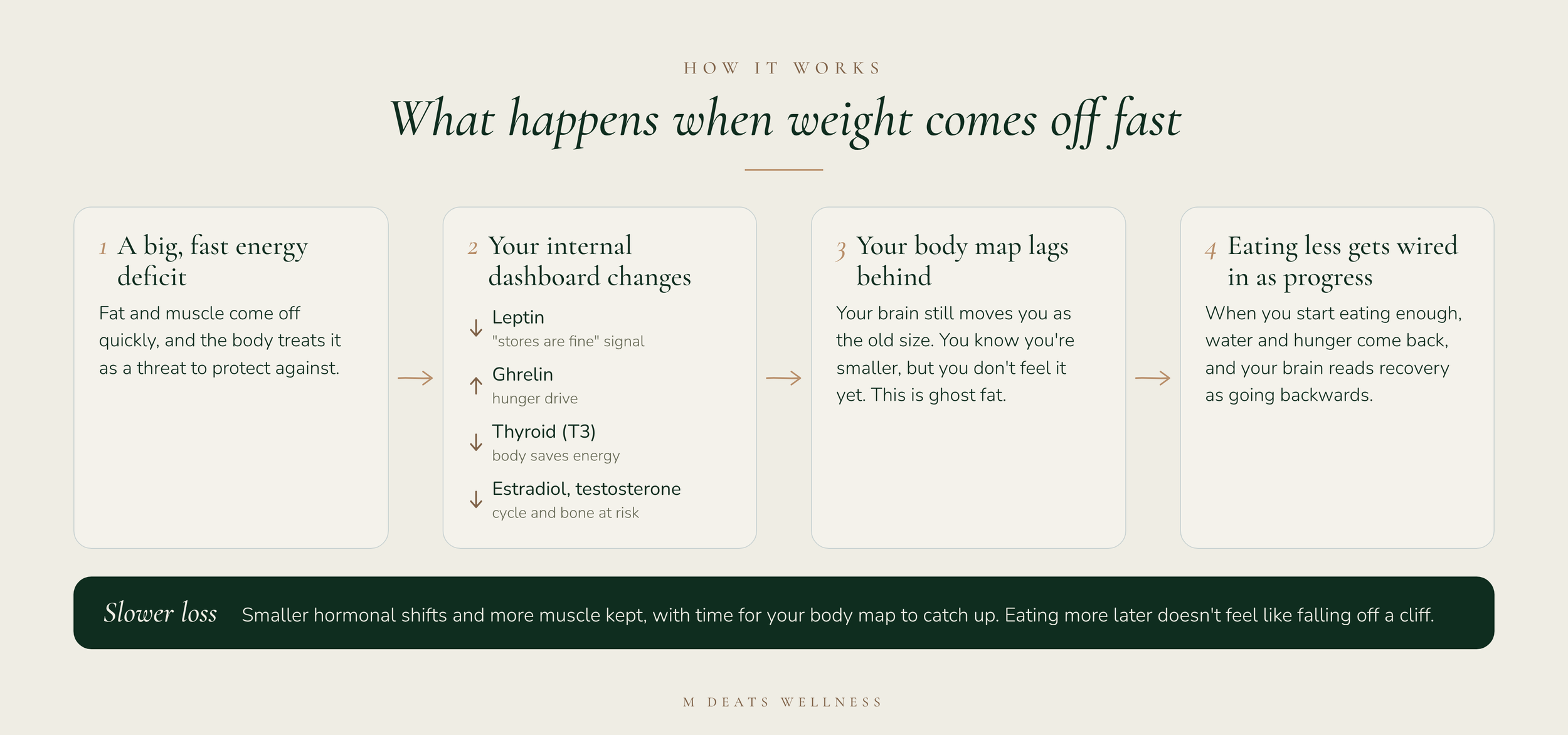
When weight comes off fast, the body can change faster than the map. Researchers call the result ghost fat, where people who know they're smaller still move, choose clothes and judge spaces as though they're not (Souza et al. 2023). In one study, people whose weight had gone up and down often over five years perceived their belly, hips, thighs and lower back as larger than they were, whatever they weighed at the time (Propice et al. 2024).
What a deficit does to the signals
An energy deficit rewrites the messages your brain is reading. Leptin, the hormone that tells your brain your stores are fine, falls as fat is lost. Ghrelin, which drives appetite, tends to climb. Your active thyroid hormone, T3, often drops as your body tries to save energy. This is what happened to me at an extreme version, I lost my hair and was cold all the time, my lips were also blue. It caused a lot of issues for me metabolically.
In a study of female fitness competitors who dieted hard for about four months, leptin, T3, testosterone and estradiol all fell, and menstrual irregularities went up (Hulmi et al. 2016). The reassuring part is that most of it recovered within a few months of eating more.
Speed matters here too. Losing weight quickly tends to mean a bigger drop in resting metabolic rate and more muscle lost than losing a similar amount slowly (Ashtary-Larky et al. 2020). When low energy availability goes on long enough, it can stop ovulation, slow bone formation and raise your risk of fractures. The International Olympic Committee's consensus on Relative Energy Deficiency in Sport sets this out clearly, and it applies to women who ride, run and lift for the love of it as much as to elite athletes (Mountjoy et al. 2023). As a trail runner, this one is close to home for me and I also lost a lot of muscle when I was on that program and lost weight fast. I felt good in many ways but the metabolic consequences became evident after several months, especially when I started training again and not eating enough to keep up with demand.
When restriction gets wired in as progress
This is the part I most want you to understand and it’s the part I struggled with for a long time too. After months or years of under-fuelling, your brain learns an association: eating less is where things happen. The scale moved there, your clothes changed there, and the feeling of being on track lived there.
So when you start eating more, a lot happens at once. Glycogen refills and brings water with it. (3 grams of water for every 1 gram of glycogen stored in the body (a roughly 1:3 ratio) That is a lot and can look like a loss of progress on the scale. Hunger that's been muted for ages comes back online. The scale will change. Your body is recovering, but your brain is still running the old prediction, so it reads every bit of that as going backwards. The old number keeps calling to you as the safe one, even though for your body now it's a deficit again.
I watched this for years with the women I coached and myself! They'd get brilliant results, then panic over a kilo of water and feel anxious about eating anything outside the plan. A few came back to me months later with the weight back on, feeling like they'd spent the money and landed right back at the start. I hated sitting with that. Their internal map just hadn't caught up, and the plan had never taught them what to do when life got in the way. I had coached them but the map was so strong and many of them just became afraid to eat more and watched the scale change as a reflection of their progress.
I know a version of this myself. On a strict plan I felt so good that eating more seemed pointless and it was convenient to be honest, and for someone who trains, that's a risky place to be. It's a big part of why I now care more about how weight comes off than how fast. I have tanked my metabolism more than once and for several reasons not just eating enough practically but there was a big psychological part to it, you can read more about that here.
The wiring isn't permanent though. It shifts with consistent, adequate eating over weeks to months, and strength training helps by rebuilding the muscle that gives your metabolism something to support. Which is why lifting becomes so important in midlife, it starts to help your engine become stronger and more efficient at rest which is what we want. Getting your period and bone health back after long-term under-fuelling can take months, and often needs some fat mass restored as well as energy and this is a very normal part of the process albeit uncomfortable for the reasons above (Mountjoy et al. 2023). You can read more about that process here.

Why slower is more likely to stick
When you lose weight more slowly, the hormonal shifts are smaller and you keep more muscle. Your body map also gets plenty of time to update. The link between restriction and progress never gets carved in as deeply, so stepping out of a deficit later feels far less like falling off a cliff. I know it is not the easiest truth to sit with especially when you want to feel different fast but for your long term health it really is the best way.
I want to be honest about the evidence too. Metabolic adaptation is real, though for most people it's modest and doesn't seem to be the main reason weight comes back (Martins et al. 2020). What seems to matter more is how hard the whole system was pushed, and whether you come out the other side with your hunger signals, hormones and muscle intact.
So if eating enough feels wrong right now, notice that feeling, and then keep going anyway. Your body and brain are negotiating a new agreement. Give them time. Keep eating enough and keep lifting while the internal wellness hub catches up. If this feels difficult for you then always work with a qualified nutrition professional (not coach) who has lived experience and can help you with the process.
So how fast is too fast?
There isn't one perfect number, and anyone who gives you one without knowing your body, your training and your history is guessing and not good at science. The research can and does give us somewhat of a useful guide to start.
In a Norwegian study, athletes doing four strength sessions a week were randomly set to lose weight at either a slower or a faster pace. Both groups lost about the same amount overall, around five and a half percent of their body weight. The slower group, losing about 0.7% of their body weight a week, gained lean mass and got stronger along the way. The faster group, at about 1% a week, got there in fewer weeks, and their lean mass didn't budge (Garthe et al. 2011).
Those were young elite athletes, men and women, so it isn't a perfect match for a woman in midlife. It points the same way as the bigger reviews, though. For most active women I think in terms of around half to three quarters of a percent of body weight a week, rather than a set number of kilos. For a 70 kg woman, that's roughly 350 to 500 grams a week. Some weeks the scale won't move at all because of water, your cycle or a big training block, and that's normal and remember with perimenopause things are swinging wildly anyway - A more useful guide is your clothing and your energy and strength.
So if eating enough feels wrong right now, notice that feeling, and then keep going anyway. Your body and brain are negotiating a new agreement. Give them time. Keep eating enough and keep lifting while the dashboard catches up.
Questions women ask me
Is losing 1 kg a week too fast?
For a lot of women, yes. If you weigh 70 kg, a kilo a week is about 1.4% of your body weight, double the slower rate that protected muscle and strength in the athlete study above. Early on you'll often see a kilo or more come off as water, and that settles. Over the weeks that follow, a slower pace is kinder to your hormones and your muscle.
Can rapid weight loss stop your period?
It can. When you're not eating enough for the energy you burn, your body can switch off ovulation to save energy, and periods can become irregular or stop (Mountjoy et al. 2023). If your period has gone missing for three months or more and you're not pregnant, talk to your GP. In perimenopause cycles can wander anyway, so it's worth getting checked rather than guessing which one it is.
Can you fix your metabolism after dieting?
For most people, yes. A good part of the slowdown is your body responding to the deficit itself, and much of it eases once you're eating enough again (Martins et al. 2020). In the fitness competitor study, most hormones had recovered within a few months of eating more (Hulmi et al. 2016). Strength training helps by rebuilding muscle. But it can take longer than a few years.
Why do I gain weight when I start eating more?
It is mostly water. Your body stores carbohydrate as glycogen in your muscles and liver, and glycogen is stored with water. So when you start eating enough, especially carbs, the scale can jump a kilo or so in the first week or two. That's your fuel tank filling back up, ready for training. Can you gain fat as well? Yes you can and it is also a normal part of the process.
Learning to Fuel for a changing body takes courage and time.
Listen to the full episode on The Sérénité Women's Wellness Podcast.
References
Ashtary-Larky, D. et al. (2020). Effects of gradual weight loss v. rapid weight loss on body composition and RMR: a systematic review and meta-analysis. British Journal of Nutrition, 124(11), 1121–1132.
Craig, A.D. (2002). How do you feel? Interoception: the sense of the physiological condition of the body. Nature Reviews Neuroscience, 3(8), 655–666.
Guardia, D. et al. (2013). Body distortions after massive weight loss: lack of updating of the body schema hypothesis. Eating and Weight Disorders, 18(3), 333–336.
Hulmi, J.J. et al. (2016). The effects of intensive weight reduction on body composition and serum hormones in female fitness competitors. Frontiers in Physiology, 7, 689.
Martins, C. et al. (2020). Metabolic adaptation is not a major barrier to weight-loss maintenance. American Journal of Clinical Nutrition, 112(3), 558–565.
Mountjoy, M. et al. (2023). 2023 International Olympic Committee's (IOC) consensus statement on Relative Energy Deficiency in Sport (REDs). British Journal of Sports Medicine, 57(17), 1073–1097.
Propice, K. et al. (2024). Morphological changes and body representation: a study of the link between weight cycling and body schema disturbances. Journal of Behavioral and Cognitive Therapy, 34(4), 100507. doi:10.1016/j.jbct.2024.100507
Souza, A.L.L. et al. (2023). Ghost fat: altered female body perception after bariatric surgery. Perceptual and Motor Skills, 130(1), 301–316.
About the Author: Combining professional expertise with personal insight, I am a nutritional scientist dedicated to changing the conversation around women's hormonal health. Having navigated the hidden complexities of HRT over-treatment myself, I bridge the gap between clinical research and real-world experience to ensure women have the tools they need to advocate for their health. If you're a woman in perimenopause struggling with metabolic health despite doing "all the right things," the missing piece might be understanding your unique internal landscape.
